How to apply for an internship in Germany: CV, cover letter and documents
What a German CV (Lebenslauf) and cover letter (Anschreiben) look like, which documents to attach, when to apply and how to follow up — for internships and working-student jobs.
By the InternsValley team · Updated

German applications follow their own conventions. They are more structured than in many countries, recruiters expect complete documents, and small things — a clear file name, the right dates for a mandatory internship — make a difference. This guide shows what goes into your CV and cover letter, which documents to attach, and how the process usually runs.
The CV (Lebenslauf)
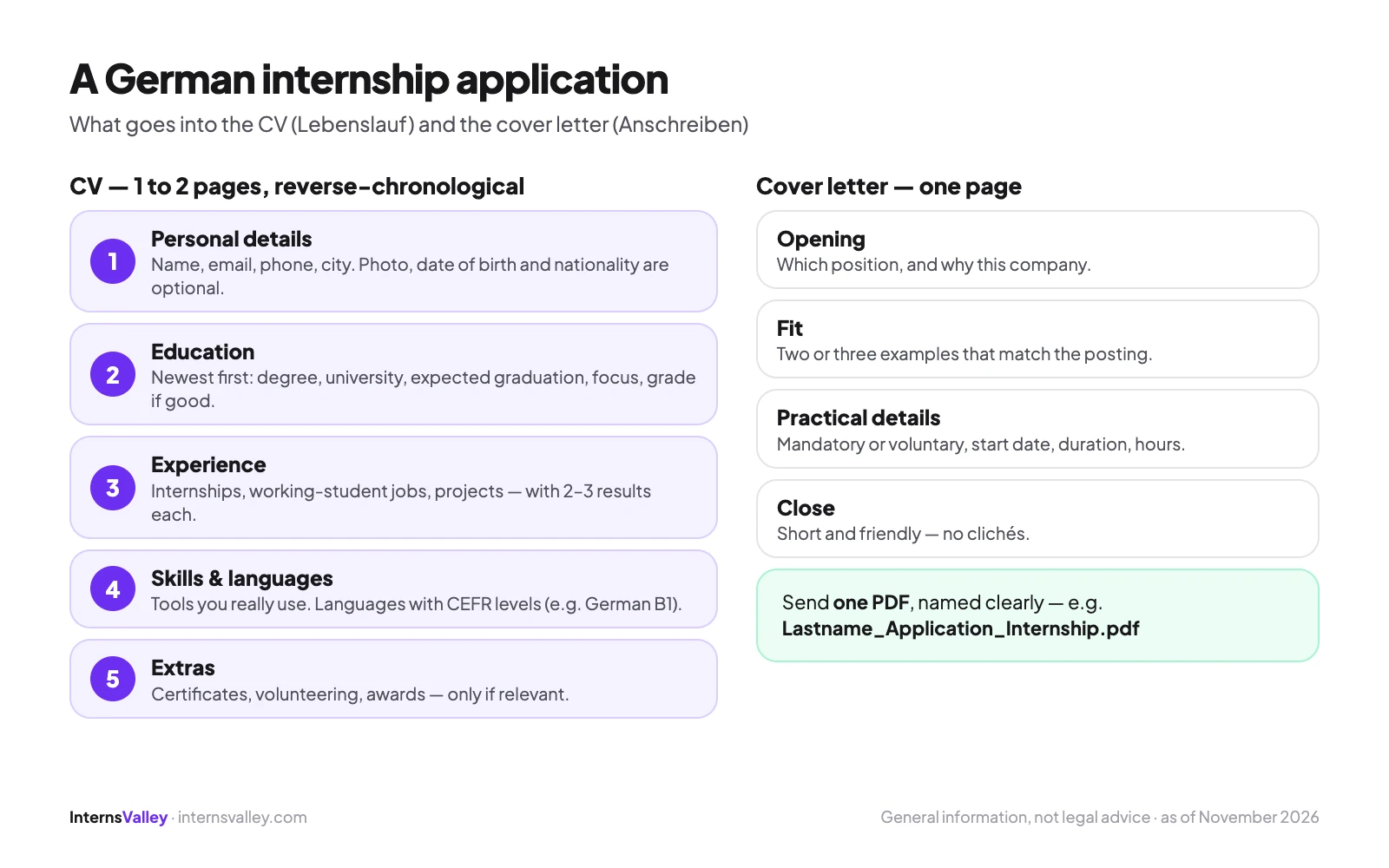
German CVs are reverse-chronological (newest first), factual and usually one to two pages long. Use these sections:
- Personal details: name, email, phone number, city. A photo, date of birth, nationality and marital status are optional — employers may not require them, and many international companies prefer CVs without a photo. If you include a photo, use a professional one.
- Education: your current degree, university, expected graduation date and focus areas. Add your grade if it's good. For a mandatory internship, mention the semester you're in.
- Experience: internships, working-student jobs, research assistant roles and relevant projects. For each, add two or three concrete results ("built a dashboard used by 40 colleagues") instead of a list of duties.
- Skills and languages: tools and methods you really use. List languages with CEFR levels — for example "German B1, English C1". Recruiters read these levels literally.
- Extras: certificates, volunteering, awards — only if they are relevant.
Keep the layout clean: one column or two, a readable font, no long paragraphs. A signature and date at the bottom were common in the past but are not needed today.
The cover letter (Anschreiben)
The cover letter is still expected by many German companies, especially larger ones. Keep it to one page:
- Opening: which position you're applying for and why this company — something specific, not "I have always been passionate about…".
- Fit: two or three examples from your studies or experience that match the requirements in the posting.
- Practical details: whether it's a mandatory or voluntary internship, your possible start date, the duration and — for working-student jobs — your weekly hours.
- Close: short and friendly. "I look forward to hearing from you" is enough.
Address a person by name if the posting gives one. Some start-ups replace the cover letter with a few questions in their application form — then answer those carefully instead.
Documents to attach
- CV and cover letter.
- Transcript of records (Notenspiegel or Transcript of Records) from your current degree.
- Certificates (Zeugnisse) from previous internships or jobs. In Germany, employers write formal references — ask for one at the end of every internship.
- Enrolment certificate (Immatrikulationsbescheinigung) — usually needed for internships and working-student jobs, sometimes only after an offer.
- For a mandatory internship: the relevant part of your study regulations or a confirmation from your internship office.
Combine everything into one PDF with a clear file name, for example Lastname_Application_Internship_Marketing.pdf, unless the company's portal asks for separate files.
English or German?
Use the language of the posting. If the posting is in English, apply in English — even at a German company. If it is in German and says German is required, apply in German. If it's in German but says English is fine, an English application is usually OK; a short German sentence at the start shows goodwill.
Not sure whether the team works in English? On InternsValley the language label quotes the posting. Start with English-speaking internships.
When to apply
- Large companies: 4–6 months ahead. Summer internships are often filled by March.
- Start-ups and smaller companies: 1–3 months ahead; some hire within a few weeks.
- Working-student jobs: often filled quickly — apply as soon as you see a fitting role.
- Theses: 4–6 months before you plan to register — see finding a thesis in industry.
After you apply
- Confirmation: most companies send an automatic confirmation. If nothing comes, check your spam folder.
- Follow-up: if you hear nothing for two to three weeks, a short, polite email to the recruiter is fine.
- Interviews: usually a short phone or video call, then one or two interviews with the team. Some companies add a small task or case study.
- Questions to ask: what you'll work on, who supervises you, working hours, pay, remote options and — for non-EU students — whether the internship counts toward your work limit.
- The offer: get the contract in writing before you start, with duration, hours, pay and holidays.
Common mistakes
- One generic letter for every company. Recruiters notice.
- Missing dates: for internships, the start date and duration are the first things recruiters check.
- Overstating German skills. If your CV says C1, the interview may switch to German.
- Sending a Word file. Always send PDF.
Found a position you like? Browse all internships or working student jobs — every listing links to the company's original posting.
Frequently asked questions
Do I need a photo on my CV in Germany?
No. A photo is optional and employers may not require it. Many international companies prefer CVs without a photo.
Should I apply in English or German?
Use the language of the posting. If the posting is in English, apply in English.
Which documents do I need for an internship application?
Usually a CV, a cover letter, your transcript of records and certificates from previous jobs or internships. For a mandatory internship, add proof from your university.
Ready to look? Every listing is labelled for language, type and pay.
Find an internship to apply for →General information, not legal advice. Laws and rates change, and your situation may differ — check with your university, the employer or your Ausländerbehörde. Spotted a mistake? Email us via the details in the Impressum.