Working student (Werkstudent) in Germany: hours, salary, insurance and tax (2026)
The 20-hour rule, what a Werkstudent earns, which social insurance you pay, student health insurance, income tax and the extra rules for non-EU students — explained for 2026.
By the InternsValley team · Updated

A working student job (Werkstudentenstelle) is the most popular way for students in Germany to earn money and gain experience in their field at the same time. It comes with a special status in social insurance that makes it cheaper for you and your employer — as long as you follow a few rules. Here is everything you need to know for 2026.
Who counts as a working student?
You can work as a Werkstudent if you are enrolled as a regular student at a university or university of applied sciences in Germany and your studies are your main occupation. The job doesn't have to match your degree, but most working-student positions are related to it — in software, marketing, finance, engineering, HR and many other fields.
Your status usually ends when you are no longer enrolled — for example at the end of the month in which you finish your final exams. During a leave semester (Urlaubssemester) the status normally doesn't apply. If you're unsure, ask your employer's payroll team or your health insurer.
The 20-hour rule
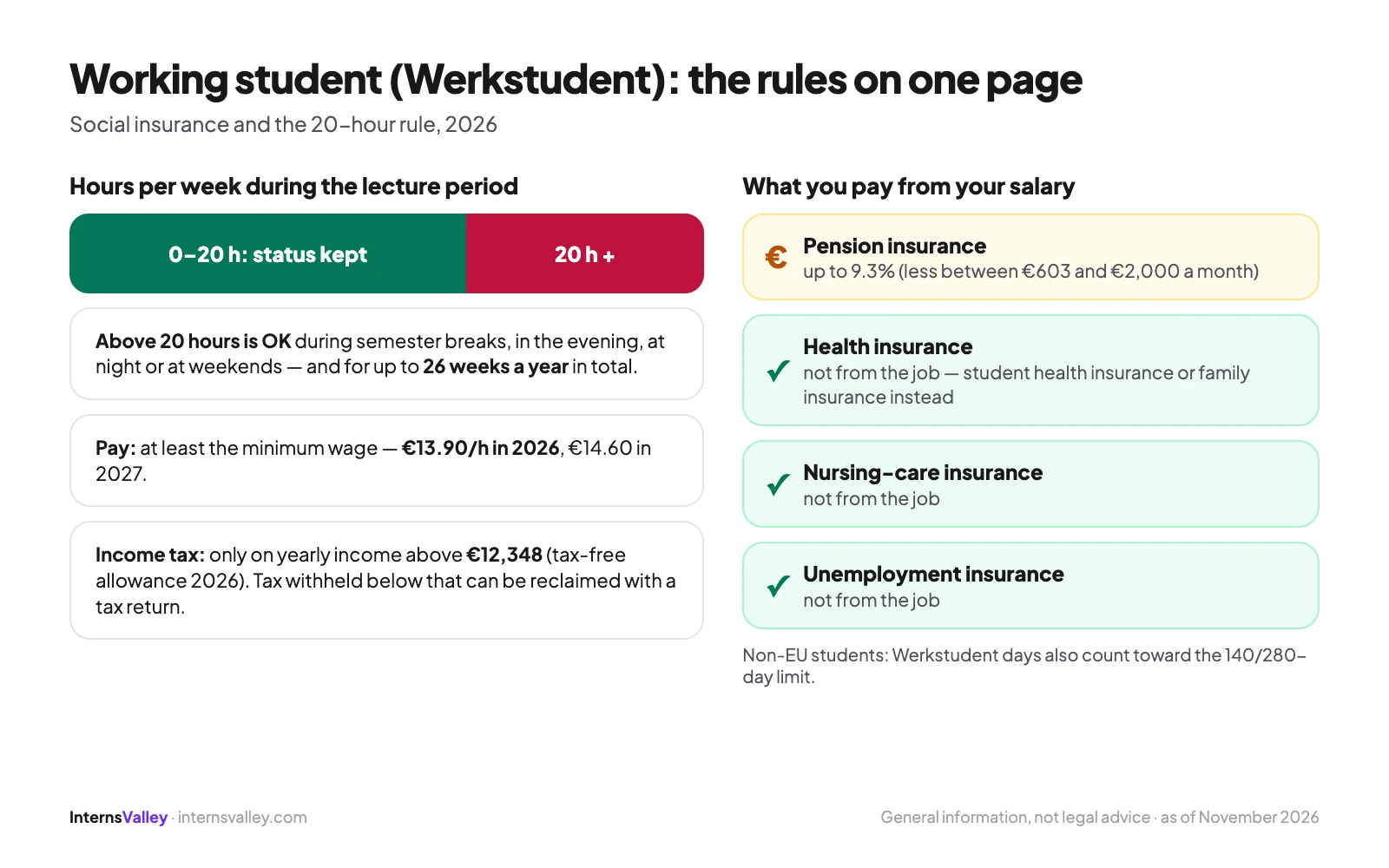
During the lecture period you may work up to 20 hours a week. That keeps the job in the working-student category, because your studies still come first.
You may work more than 20 hours when:
- it's the semester break (vorlesungsfreie Zeit),
- you work mainly in the evenings, at night or at weekends, or
- the extra hours are limited — in total, more than 20 hours a week is allowed for up to 26 weeks per year.
If you regularly work more than 20 hours a week during the semester, you lose the working-student status and pay full social-insurance contributions like a regular employee.
How much does a Werkstudent earn?
Working students are employees, so the minimum wage applies: €13.90 per hour in 2026 and €14.60 per hour from 2027. Many companies — especially in tech, consulting and finance — pay more.
| Hours per week | Monthly gross at €13.90 (2026) | Monthly gross at €14.60 (2027) |
|---|---|---|
| 10 hours | ≈ €602 | ≈ €632 |
| 15 hours | ≈ €903 | ≈ €948 |
| 20 hours | ≈ €1,204 | ≈ €1,264 |
If you earn €603 a month or less (2026; €633 in 2027), the job is treated as a mini-job instead, with its own rules.
Social insurance: what is deducted?
This is the big advantage of the working-student status:
- Pension insurance: yes — up to 9.3% of your gross pay. On monthly pay between €603 and €2,000 the contribution is reduced (the so-called transition zone).
- Health insurance: not deducted from the job. You stay in student health insurance or family insurance.
- Nursing-care insurance: not deducted from the job.
- Unemployment insurance: not deducted from the job.
Your employer pays its own share of pension insurance on top. The pension contributions also count toward your future German pension.
Health insurance as a working student
Health insurance is compulsory in Germany. As a working student you are usually covered in one of these ways:
- Family insurance through a parent with statutory insurance — free, but only up to age 25 and only if your income stays low.
- Student health insurance (Krankenversicherung der Studenten) — a reduced monthly rate, in 2026 roughly €130–150 including nursing-care insurance, depending on your insurer and age. It is available until the end of your 14th semester or your 30th birthday.
- Private insurance, which some international students have from their visa application. Check that it is recognised for your situation.
Tell your health insurer about your working-student job — they will check that your status is correct.
Income tax
Working students pay income tax like everyone else, but only on income above the basic tax-free allowance (Grundfreibetrag) of €12,348 in 2026. Your employer deducts wage tax each month based on your tax class (usually class I). If your yearly income ends up below the allowance, you can get the tax back by filing a tax return — it's often worth it.
You need a tax identification number (Steuer-ID), which you receive by post after registering your address in Germany.
Holidays and sick pay
Because you are an employee, you have the same basic rights as other staff:
- Paid holiday: at least 20 working days a year for a five-day week, reduced in proportion to your working days. If you work two days a week, that is at least 8 days off a year.
- Sick pay: after four weeks with the employer you are paid while you are ill, usually for up to six weeks. Bring a doctor's note as your contract requires.
Extra rules for non-EU students
If you study on a student residence permit, you may work 140 full days or 280 half days per year. A working-student job counts toward this limit. A day with up to four hours of work counts as a half day, so working four hours on five days a week uses five half days that week. Plan your contract so you stay within the limit, and keep a record of your working days. Read more in work rules for non-EU students.
Checklist before you sign
- Are the weekly hours 20 or less during the semester?
- Is the hourly pay at least €13.90 (2026)?
- Does the contract state holidays, notice period and duration?
- Have you sent your enrolment certificate (Immatrikulationsbescheinigung) to the employer — and will you send a new one every semester?
- Non-EU: does the job fit into your remaining days this year?
Ready to look? Browse working student jobs, or search by city — for example Werkstudent jobs in Berlin.
Frequently asked questions
How many hours can a Werkstudent work per week?
Up to 20 hours a week during the lecture period. More is possible during semester breaks, in the evenings, at night or at weekends, and for up to 26 weeks a year in total.
How much does a working student earn in Germany?
At least the minimum wage: €13.90 per hour in 2026 and €14.60 in 2027. Many companies, especially in tech, pay more.
Which social insurance does a working student pay?
Only pension insurance — up to 9.3% of gross pay, less on monthly pay between €603 and €2,000. Health, nursing-care and unemployment insurance are not deducted from the job.
Do working students pay income tax?
Only if their yearly taxable income exceeds the basic allowance of €12,348 (2026). Tax withheld from the salary can be reclaimed with a tax return.
Ready to look? Every listing is labelled for language, type and pay.
Browse working student jobs →General information, not legal advice. Laws and rates change, and your situation may differ — check with your university, the employer or your Ausländerbehörde. Spotted a mistake? Email us via the details in the Impressum.