Internship in Germany for international students: the complete guide (2026)
Everything international students need for an internship in Germany: work permits, mandatory vs. voluntary, language, pay, where to find positions and what to do after you sign.
By the InternsValley team · Updated

Germany is one of the best places in Europe to do an internship: thousands of companies hire interns every semester, many teams work in English, and most internships are paid. But the rules are different from what you may know from home — especially if you are not from the EU. This guide walks you through the whole process, from checking your permit to your first day.
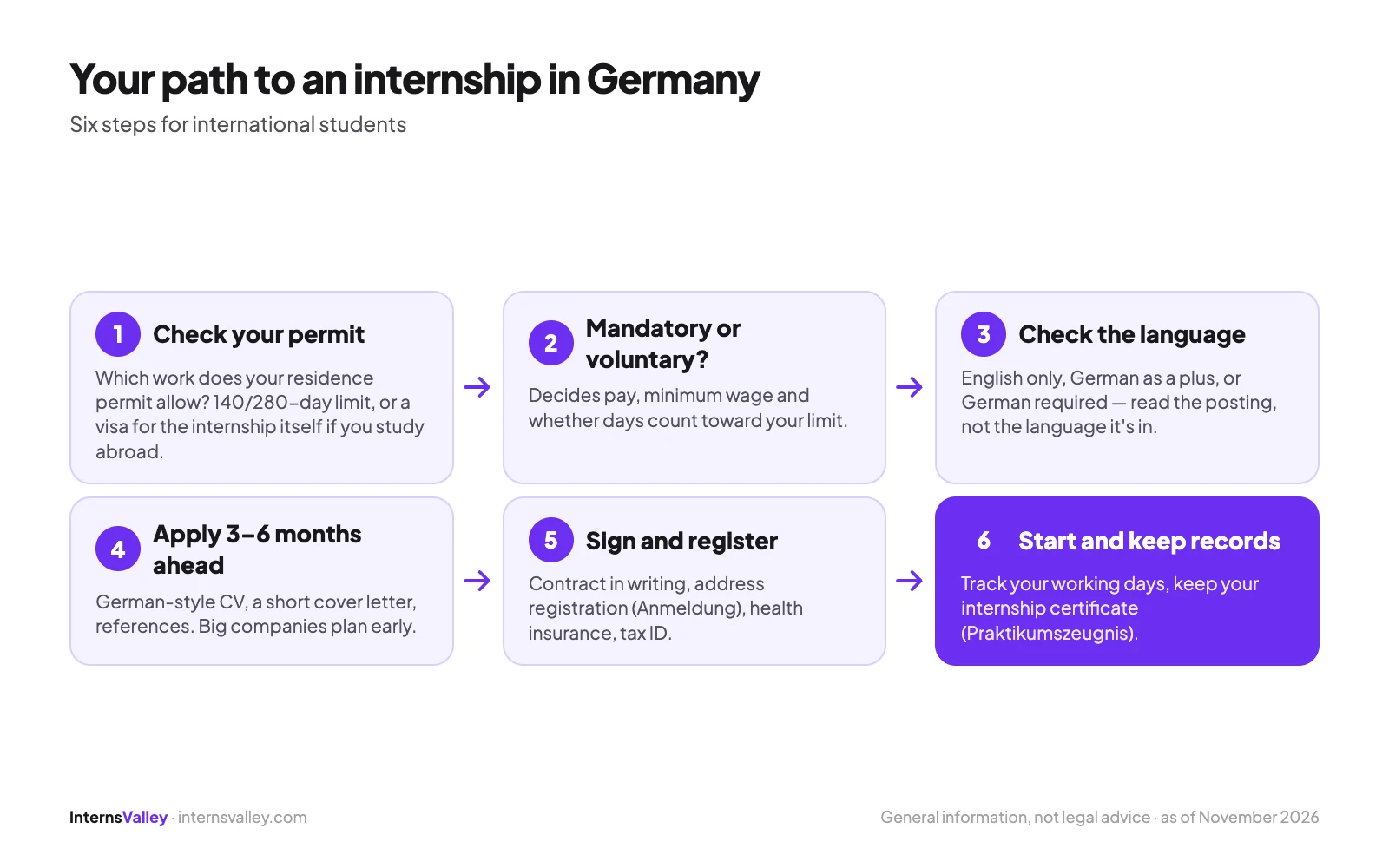
Step 1: Check what your residence status allows
What you are allowed to do depends on where you study and where you're from.
- EU, EEA and Swiss citizens can work and do internships in Germany without any permit — just like Germans.
- Non-EU students enrolled at a German university (residence permit under § 16b AufenthG) may work 140 full days or 280 half days per calendar year. Mandatory internships required by your study regulations don't count toward this limit; voluntary internships do. Our guide on work rules for non-EU students explains the counting in detail.
- Students enrolled at a university outside Germany usually need a visa for the internship before travelling. In many cases the Federal Employment Agency has to approve the internship. Exchange programmes such as Erasmus+, DAAD or IAESTE can make this much easier. Ask the German embassy or consulate in your country early — appointments can take weeks.
- Graduates of German universities can stay for up to 18 months to look for a job and may work without restriction in that time, including internships.
If your residence permit lists special conditions (Nebenbestimmungen), those always take priority. When in doubt, ask your university's international office or your local Ausländerbehörde before you sign.
Step 2: Find out whether you need a mandatory or a voluntary internship
In Germany the word Praktikum covers two very different things, and the difference affects your pay, your work limit and your insurance:
- A Pflichtpraktikum (mandatory internship) is required by your study or examination regulations — for example a practical semester. The minimum wage doesn't apply, and it doesn't count toward the 140-day limit.
- A freiwilliges Praktikum (voluntary internship) is your own choice. If it lasts longer than three months, you must be paid at least the minimum wage from day one, and it counts toward the 140-day limit.
Check your Prüfungsordnung or ask your faculty's internship office whether your programme requires an internship, how long it must be and what it has to cover. Read the full comparison in Pflichtpraktikum vs. voluntary internship.
Step 3: Check the language requirement — properly
Many German postings are written in English but still expect German in daily work. Others are written in German but the team works in English. So read what the posting requires, not which language it is written in:
- “English is our working language” or “no German required” → English is enough.
- “German is a plus” or “Deutschkenntnisse von Vorteil” → English is enough to apply; German helps.
- “fließende Deutschkenntnisse”, “verhandlungssicheres Deutsch” or “C1” → the job is done in German.
On InternsValley, every listing shows a language label with the exact quote from the posting. You can browse only the English-speaking internships. Even when German isn't required, a basic course (A1–A2) on your CV shows you're serious about living here.
Step 4: Understand pay and the minimum wage
Most internships in Germany are paid, but the law only requires the minimum wage in some cases:
| Type of internship | Minimum wage required? | Typical pay |
|---|---|---|
| Mandatory internship (Pflichtpraktikum) | No | Often a monthly allowance; varies a lot |
| Voluntary, up to 3 months, during studies | No (first internship with this employer) | Often a monthly allowance |
| Voluntary, longer than 3 months | Yes, from day one | At least €13.90/h (≈ €2,400/month full-time) |
| Internship after graduation | Yes, from day one | At least €13.90/h |
| Working student job (Werkstudent) | Yes | At least €13.90/h |
Want the details, including how to check whether a monthly offer meets the minimum wage? Read Minimum wage for interns.
Step 5: Where to find internships
- Company career pages are where most positions are posted first. InternsValley collects them from more than a thousand company career pages twice a day and labels each one, so you don't have to check them one by one. Start with all internships or a city such as Berlin or Munich.
- Your university's career service often has partner companies, job fairs and CV checks — free of charge.
- Professional networks like LinkedIn are useful for following companies and contacting recruiters.
- Speculative applications (Initiativbewerbung) work well at small and mid-sized companies that don't advertise every role.
If you want a part-time job during the semester rather than a full-time internship, look at working student jobs — they are a common way to gain experience while studying.
Step 6: Apply the German way
German applications are more formal than in many other countries. You usually send a CV (Lebenslauf), a one-page cover letter (Anschreiben), your transcript and references from earlier jobs. Apply in the language of the posting, and for a mandatory internship say so — with the dates your university requires. Our guide How to apply for an internship in Germany shows exactly what goes into each document.
Step 7: After you sign
- Contract: your employer must give you the main terms in writing — duration, working hours, pay, holidays and learning goals (Nachweisgesetz).
- Address registration: if you move to a new city, register your address (Anmeldung) at the local citizens' office within two weeks.
- Health insurance: it is compulsory in Germany. Students are usually covered by student health insurance or family insurance; check with your insurer how the internship affects it.
- Tax ID: you receive your tax identification number by post after registering your address. Your employer needs it for payroll.
- Bank account: you'll need one for your salary.
- Keep records: non-EU students should note every working day. At the end, ask for an internship certificate (Praktikumszeugnis) — it matters for future applications in Germany.
Common mistakes to avoid
- Starting a voluntary internship without checking your day limit. Unpaid voluntary internships still count toward the 140 days.
- Assuming “English posting” means “English team”. Read the requirements.
- Applying too late. For summer internships, many large companies decide by March.
- Not getting the terms in writing. Pay, hours and holidays should be clear before your first day.
New to the labels? See how we classify listings, or start browsing English-speaking internships.
Frequently asked questions
Can international students do an internship in Germany?
Yes. Students enrolled at a German university can do internships alongside their studies; non-EU students must respect the 140 full / 280 half day limit, which doesn't apply to mandatory internships. Students enrolled abroad usually need a visa for an internship in Germany.
Do I need to speak German for an internship in Germany?
Not always. Many start-ups and international companies work in English, especially in Berlin and Munich. On InternsValley, the language label quotes what each posting requires.
Are internships in Germany paid?
Most are. Voluntary internships longer than three months must pay at least the minimum wage (€13.90 per hour in 2026). Mandatory internships and voluntary internships of up to three months are exempt, but many companies still pay.
When should I apply for an internship in Germany?
Three to six months before you want to start. Large companies often fill summer internships by early spring.
Ready to look? Every listing is labelled for language, type and pay.
Browse English-speaking internships →General information, not legal advice. Laws and rates change, and your situation may differ — check with your university, the employer or your Ausländerbehörde. Spotted a mistake? Email us via the details in the Impressum.