Work rules for non-EU students in Germany (140/280 days)
The 140 full-day / 280 half-day limit, how days are counted, which internships and jobs count, working-student jobs and what to check with your Ausländerbehörde.
By the InternsValley team · Updated

If you study in Germany on a student residence permit (§ 16b AufenthG) and you are not from the EU, the EEA or Switzerland, your right to work is limited. EU/EEA and Swiss students can work like German students. This guide explains the yearly limit, how days are counted, which jobs and internships count, and what to do if you need more.
The basic limit: 140 full days or 280 half days
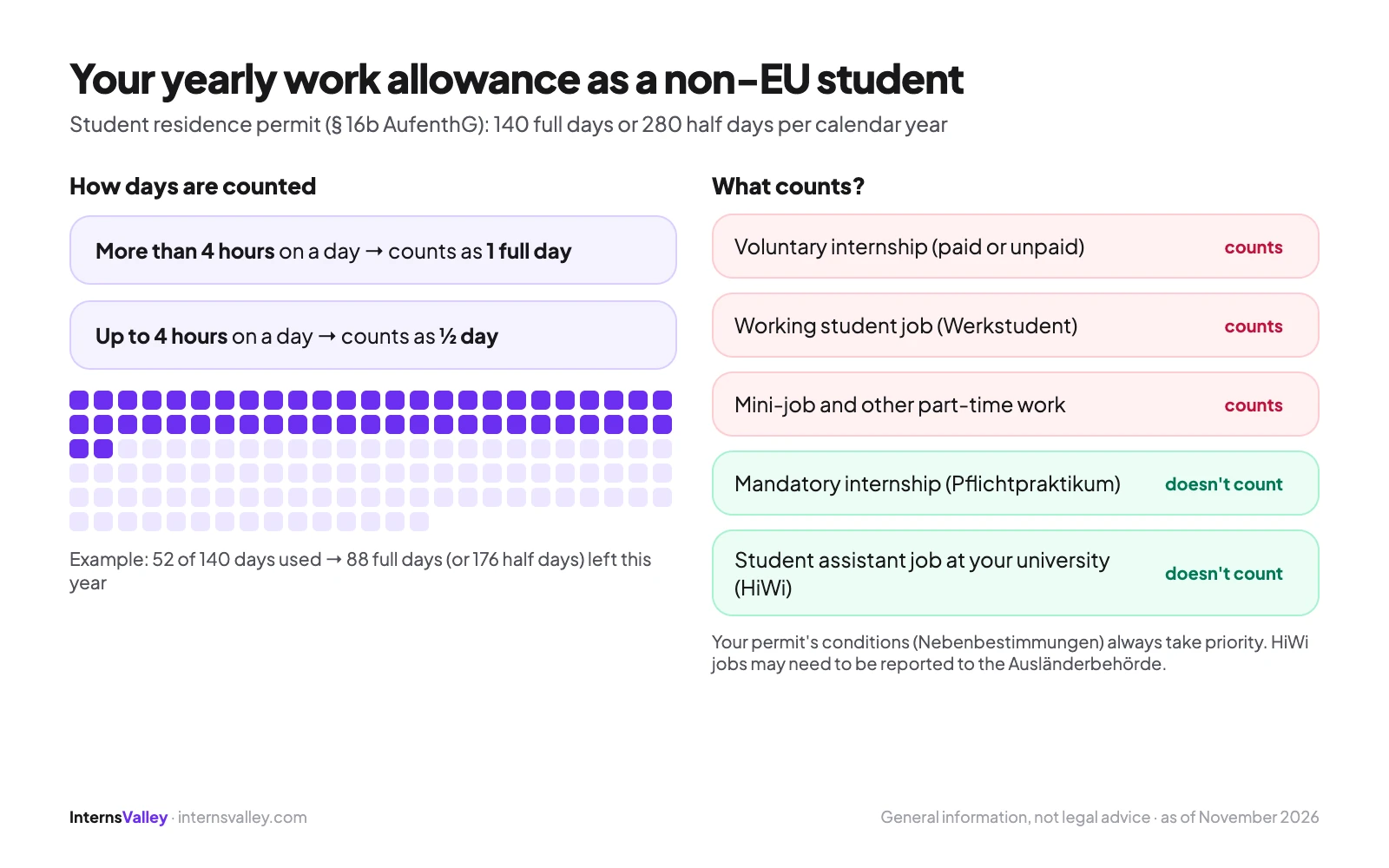
You may work up to 140 full days or 280 half days per calendar year without asking anyone. The limit was raised from 120/240 days on 1 March 2024. The account resets every 1 January.
Your residence permit states the conditions that apply to you (Nebenbestimmungen), often with a sentence like "Beschäftigung bis zu 140 Tage oder 280 halbe Tage im Jahr sowie Ausübung studentischer Nebentätigkeit erlaubt". If your permit says something different, your permit wins — ask your Ausländerbehörde.
How days are counted
- A working day of more than four hours counts as one full day.
- A working day of up to four hours counts as half a day.
- Holidays and sick days don't count as working days.
- You can mix both: for example 100 full days plus 80 half days (= 40 full days) uses up the whole year.
Example: you work 4 hours on Monday, Wednesday and Friday as a working student for 30 weeks. That's 3 half days × 30 weeks = 90 half days = 45 full days. You'd still have 95 full days (or 190 half days) left for the rest of the year.
What counts — and what doesn't
Does not count toward the limit:
- Mandatory internships (Pflichtpraktikum) required by your study regulations. Keep the confirmation from your university.
- Student assistant jobs (studentische Nebentätigkeit, e.g. HiWi or tutor) at your university or a university-related research institution. Some Ausländerbehörden want you to report these jobs.
Counts toward the limit:
- Voluntary internships — even if they are unpaid.
- Working-student jobs (Werkstudent), mini-jobs and other part-time work.
- Paid work during semester breaks.
Not allowed without permission: self-employment and freelancing. You need approval from the Ausländerbehörde before you start any self-employed work.
Working students and the 20-hour rule
Separately from residence law, there is a social-insurance rule: if you work more than 20 hours a week during the lecture period, you may lose your working-student status (Werkstudentenprivileg) and pay full social-insurance contributions. During semester breaks you can usually work more. Both rules apply at the same time — the 20-hour rule for insurance and the 140/280-day rule for your permit. See the full working student guide.
Special cases
- Language courses and preparatory courses (e.g. Studienkolleg): different and often stricter rules can apply. Check the conditions in your permit.
- After graduation: with a residence permit to look for a job (up to 18 months), you may work without these limits — including internships.
- Studying outside Germany: if you're not enrolled at a German university and want to come for an internship, you usually need a visa for that purpose. See our complete internship guide.
Practical tips
- Keep a record of the days you work each year — you are responsible for staying within the limit, and employers may ask.
- For a mandatory internship, keep the university's confirmation that it is compulsory.
- Want to work more than the limit? You need approval from the Ausländerbehörde (and usually the Federal Employment Agency) before you start.
- Plan voluntary internships carefully: a full-time voluntary internship of three months already uses around 65 full days.
- Ask your university's international office — they deal with these questions every day.
On every listing, the box “What this means for you” tells you whether that position counts toward your limit. Browse mandatory internships, which don't count.
Frequently asked questions
How many days can non-EU students work in Germany?
140 full days or 280 half days per calendar year on a student residence permit (§ 16b AufenthG). A day with up to four hours of work counts as a half day.
Does an internship count toward the 140 days?
A mandatory internship (Pflichtpraktikum) does not count. A voluntary internship counts — even if it is unpaid.
Can I work more than 140 days?
Only with permission from the Ausländerbehörde, which usually involves the Federal Employment Agency. Get it before you start.
Ready to look? Every listing is labelled for language, type and pay.
Browse mandatory internships (don't count toward the limit) →General information, not legal advice. Laws and rates change, and your situation may differ — check with your university, the employer or your Ausländerbehörde. Spotted a mistake? Email us via the details in the Impressum.